SEO vs AEO vs GEO: Do NZ Businesses Need All Three?

Tracey
Digital Marketing Specialist-
 Share
Share
-
 No Comments
 -
 10 min read
SEO, AEO, GEO: the acronyms keep multiplying, and it’s easy to feel you’re behind on strategies you didn’t know you needed. The good news? They’re less separate than they sound. AEO and GEO largely build on strong SEO fundamentals, and all three aim at the same goal: making your business easy to find, easy to understand and easy to trust, whether someone is using Google, a voice assistant or various AI tools.
So no, you don’t need three separate strategies. But it helps to know what each one adds.
We looked at aggregated, anonymised data from a selection of NZ sites we manage to see whether that holds up. Short on time? Jump straight to the data.
Key findings
- Google’s AI features made up around 17% of search impressions across the sites we looked at.
- AI features mostly showed pages that already had strong search visibility, which fits the idea that AEO and GEO build on SEO.
- AI assistants like ChatGPT sent only about 2% as many visits as Google organic search, even though Google’s AI features showed our pages a lot. Right now, AI is more about being seen than being clicked.
- Guides and comparisons looked a little more likely to surface in AI features, though the pattern varied by site.
From the team
“A question we hear often is whether businesses should shift budget from SEO to AI search. What we see in the data is that the pages showing up in AI features are mostly the ones already doing well in Google, so the fundamentals still come first.” – Emma, Owner at Pixi Digital
The quick comparison
| Main goal | Main focus | |
|---|---|---|
| SEO Search Engine Optimisation |
Rank in search results (Google, Bing) | Technical SEO, content, links, relevance |
| AEO Answer Engine Optimisation |
Answer questions clearly (featured snippets, “People also ask”, voice search) | Clear answers, page structure, FAQs, schema |
| GEO Generative Engine Optimisation |
Appear in AI-written answers (ChatGPT, Gemini, Copilot, AI Overviews) | Authority, citations, brand and entity signals, third-party mentions |
Does any of them replace SEO? No. They build on it.
What is SEO?
Search Engine Optimisation is improving your visibility in traditional search results. When someone searches “physio Takapuna” or “commercial cleaning Auckland”, SEO is what helps your website show up. It covers technical health (speed, mobile experience, crawlability), content that matches what people search for, and authority from links and mentions on other trusted sites. Our SEO team works across all three.
What is AEO?
Answer Engine Optimisation is about making the content on your pages easy to lift out as a direct answer. Think featured snippets, “People also ask” boxes and voice assistants, where a system needs one clear response to a question. In practice, that means headings written as real questions, a short direct answer first, FAQs and lists where they help, and structured data (schema) so machines can read the page. AEO is mostly about what’s on your page.
What is GEO?
Generative Engine Optimisation is about whether AI tools like ChatGPT, Gemini, Copilot and Google’s AI Overviews choose to mention or cite your brand when they write an answer. These tools draw on sources they consider credible, so GEO goes beyond the page: original expert content, consistent brand and entity signals across the web, reviews and third-party mentions, and clear facts that AI tools can reference confidently. Our AI SEO (GEO and AEO) service covers this in practice.
What AEO and GEO look like in practice
The easiest way to tell them apart is to look at where the answer appears and what kind of question triggers it.
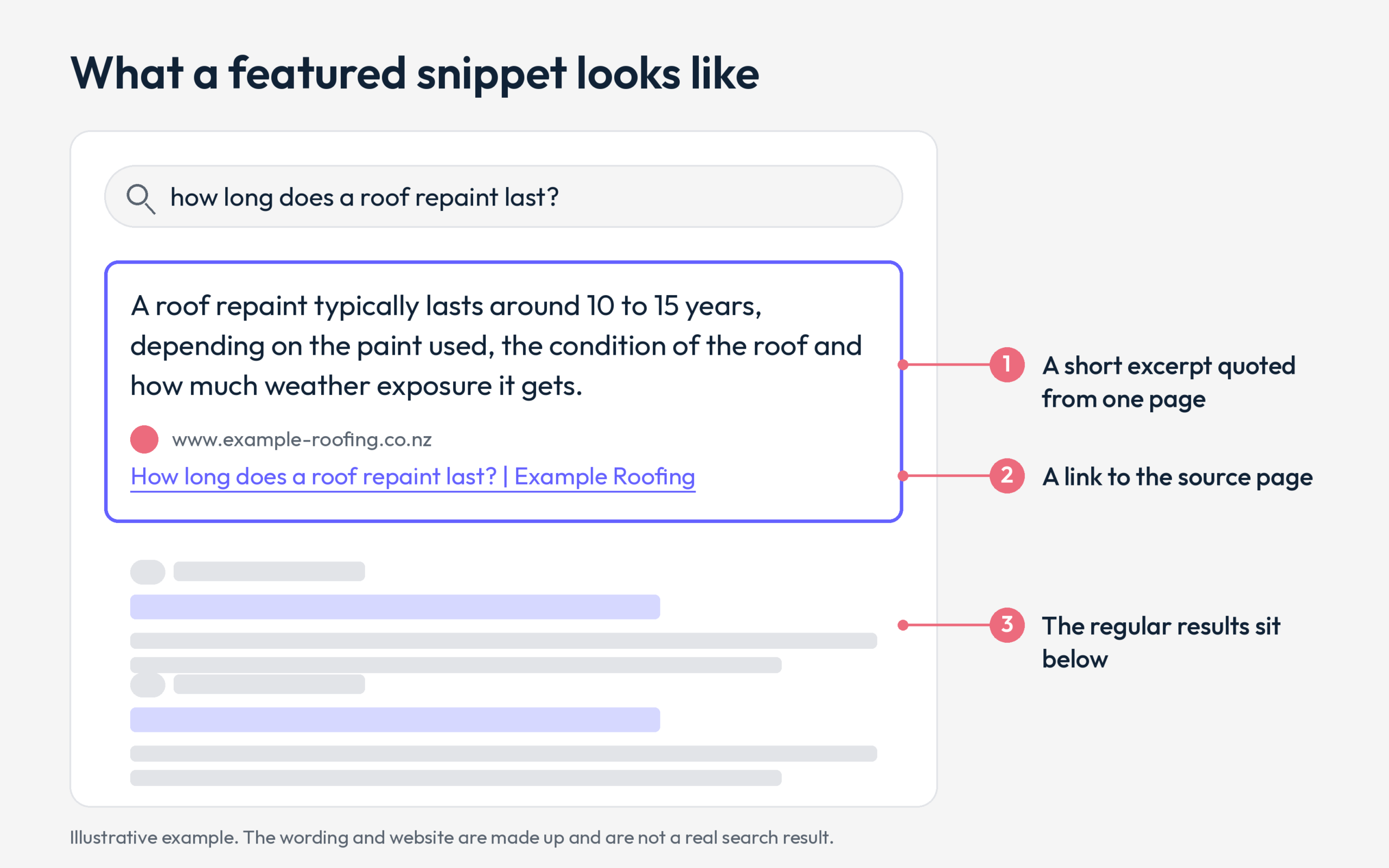
AEO: One clear answer from one page
Someone searches “how long does a roof repaint last?” and Google shows a featured snippet: a short excerpt quoted from one page, in a box at the top of the results, with a link to that page. The page with the clearest direct answer wins. “People also ask” boxes work the same way, and voice assistants often read out the same kind of excerpt. An AI Overview is different, because it’s written by AI from several sources, which puts it closer to GEO.
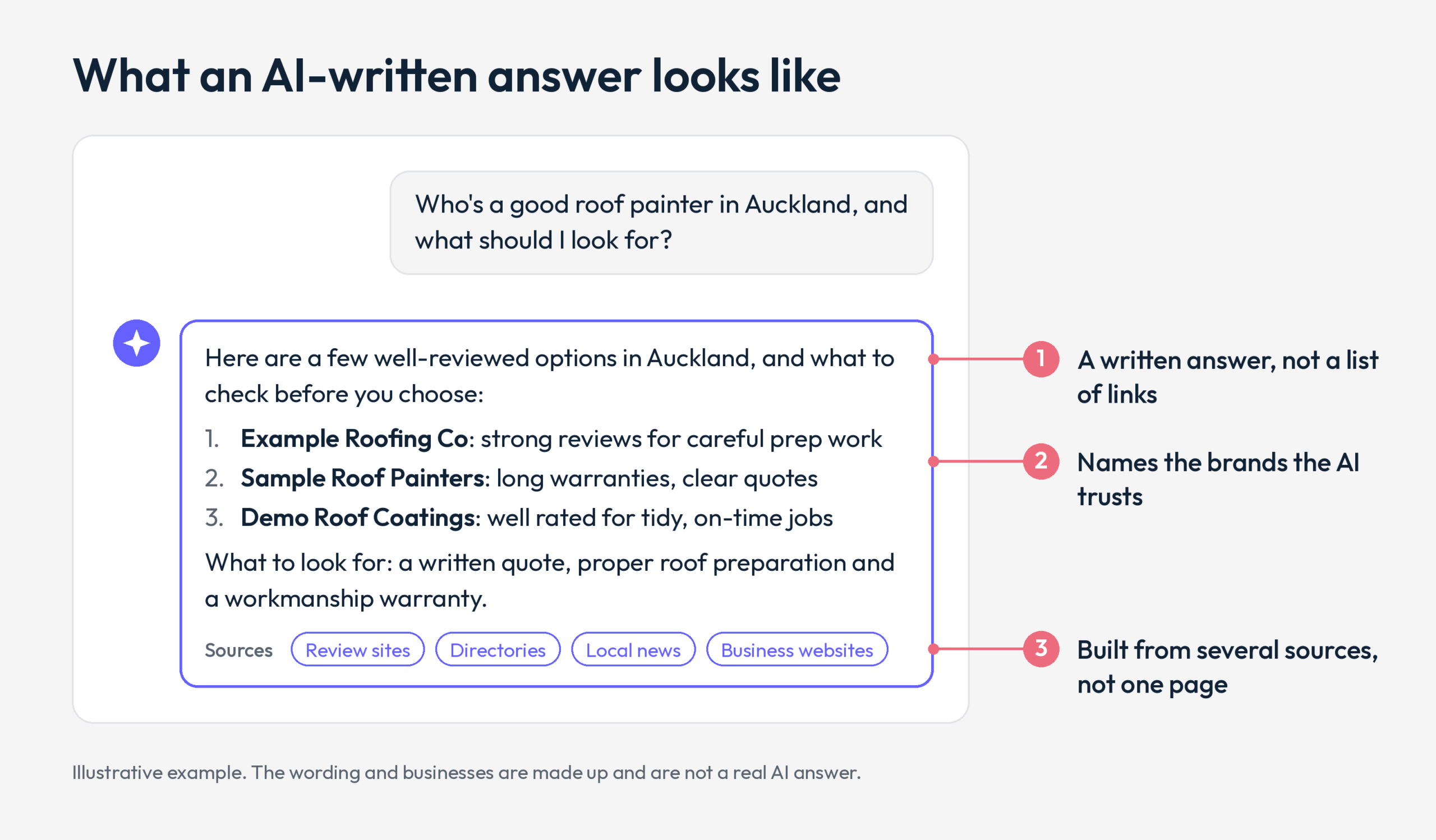
GEO: An AI-written answer that names brands
Someone asks ChatGPT “who’s a good roof painter in Auckland, and what should I look for?” and gets a written recommendation that names a few businesses. The brand the AI trusts enough to mention wins, and that depends on far more than one page: reviews, mentions elsewhere and consistent brand signals.
| AEO | GEO | |
|---|---|---|
| Typical question | “How long does a roof repaint last?” | “Who’s a good roof painter in Auckland?” |
| What the person sees | A short excerpt quoted from one page, with a link to it | A written answer that may name several brands |
| What decides who wins | How clearly your page answers the question | How much AI trusts your brand across the web |
| Where you show up | Snippets, “People also ask”, voice | ChatGPT, Gemini, Copilot, AI Overviews |
A simple rule of thumb: if the question has a short, factual answer, it’s mostly AEO territory. If it asks for a recommendation, a comparison or the “best” option, it’s mostly GEO territory. Google’s AI Overviews sit in both, because they pull clear answers from pages and also decide which brands to trust.
How they differ, and how they fit together
SEO gets you into the results. AEO makes your content the clearest, easiest answer once you’re there, because a page can rank well and still bury its answer in the fifth paragraph. GEO is about being included in an AI-written answer, which may not involve a click at all.
Put simply, AEO is about the quality of your answer and GEO is about the strength of your reputation. In practice the lines blur, and many of the same actions help both, which is why they’re often bundled together. The useful distinction is emphasis.
Think of them as layers. SEO makes you discoverable and credible, AEO makes your content easy to extract, and GEO builds the authority that makes AI tools trust and cite you. Skip the first layer and the other two get shaky, because AI tools tend to draw on established, well-ranking sources.
Still wondering whether SEO matters at all? We tackled that head on in Is SEO dead in New Zealand?
What our data shows
Everyone’s got a take on AI search, so we checked our own numbers. We combined Google’s Search Console generative AI reports with GA4 traffic data from a small sample of NZ sites across different industries.
One thing to know before we dive in: Search Console shows how often your pages appear in AI Overviews and AI Mode, by page, country and date, but not how many clicks those appearances generate. So it measures visibility, not traffic. All figures below are aggregated and anonymised.
1. AI features are a large share of what people see
Across the sample, Google’s AI features made up around 17% of all search impressions. By site, that ranged from about 11% to 24%, and on most sites the share grew over the period.
2. AI features mostly show pages that already do well in search
On every site, at least half of the top 20 pages by organic clicks also made the top 20 for AI impressions. That fits the idea that AEO and GEO build on SEO, though it doesn’t prove it: pages with lots of search visibility will naturally pick up AI impressions too. Finding 3 is a fairer test.
3. Informational content tends to surface more, but the effect varies
On the sites where we could compare page types, guides, comparisons and blog posts showed up in AI features a little more than product and category pages, relative to their organic impressions. The gap was clear on one site and small on the others, so think of it as a tendency, not a rule. Informational pages help you get seen, and commercial pages still tend to convert the clicks, which is where conversion rate optimisation pays off.
4. Two things worth watching (one site each)
On one site, a handful of free calculators appeared in AI features at roughly three times the rate of the site’s typical page, relative to their organic impressions, which fits the idea that useful tools give AI something concrete to reference. On another, AI visibility was concentrated: a single page accounted for around 17% of all AI impressions, and on a third site the top five pages accounted for over half. These are single-site observations, so treat them as things to look for in your own data, not as trends. Most sites have a handful of pages doing the heavy lifting, and those are worth protecting and improving.
5. Being seen isn’t the same as visiting
This is where the hype and the reality part ways. Google’s AI features appeared in roughly one in six of the impressions across our sample, but visits from AI assistants like ChatGPT were only about 2% of what Google organic search sent over 90 days.
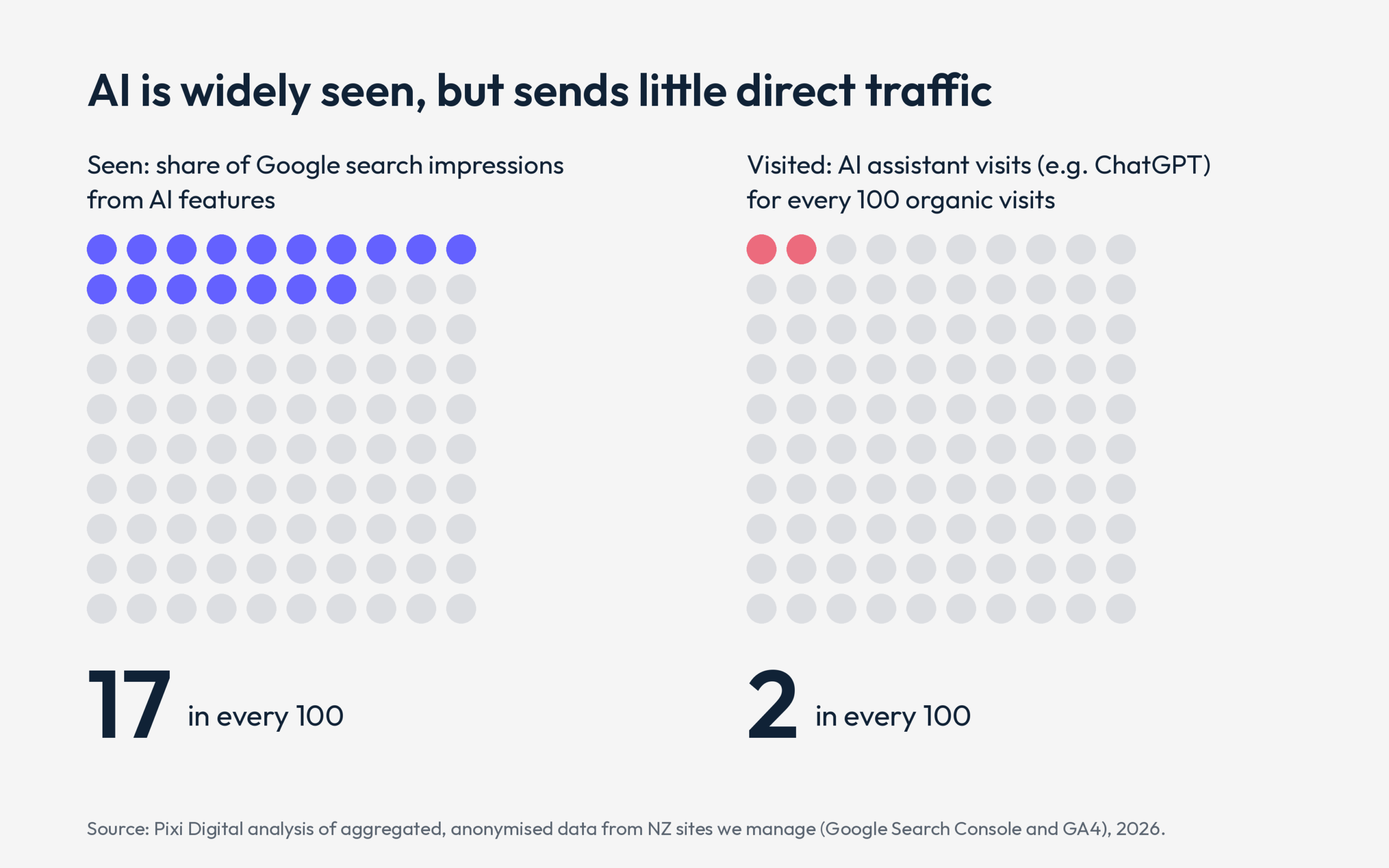
These are different measures, so they aren’t a click-through rate. Clicks from Google’s own AI features are counted in organic traffic, and Search Console doesn’t separate them out.
That doesn’t mean AI traffic is worthless, and the quality of those visits varied:
- Some sites saw a clear upside. On at least one site with online sales, AI visitors spent noticeably more per order than organic visitors, although the volume was still a tiny share of revenue.
- Others saw promising signals. On one site, AI visitors converted at a higher rate than organic visitors, but from a very small number of conversions.
- Many saw very little. Several sites recorded few AI visits and no conversions yet. At these volumes, that doesn’t tell you whether the channel works.
Most of this traffic came from ChatGPT, with Gemini and Copilot sending very little, which fits with the most popular AI chatbots in New Zealand. Some AI traffic also arrives with no referrer and gets counted as Direct, so these figures probably understate the real volume.
What this means for your business: AI search is a visibility channel first and a traffic channel second. It’s shaping which brands people see and trust, even when they don’t click straight away. That’s why we’d treat it as something to build and measure now, alongside your SEO, rather than something to fund instead of it.
A few honest caveats. This is a small sample over a few months, so treat it as what we’re seeing across the sites we manage, not a market-wide study. AI impression data only started in mid-May, so we compared totals over matching dates, and the page-level comparisons use a longer window, so think of them as a rough guide.
Questions we hear from clients
Why doesn’t AI show up in my traffic source report?
Often it does, just not where you’d expect. In GA4, visits from tools like ChatGPT and Gemini can appear as their own “AI Assistant” channel, or sit under Referral, depending on how your property is set up. Two kinds of AI-driven visit stay hidden: visits that arrive without a referrer are counted as Direct, and clicks from Google’s own AI features are counted as Google organic. Treat your AI traffic figure as a minimum. To see what you have, open the traffic acquisition report by session source, or set up a custom channel group for AI tools.
Can we see which questions led to us appearing in AI results?
Partly, and it depends on the platform. Google’s Search Console reports show impressions by page, country, device and date, but not the queries or prompts behind them. Microsoft Clarity’s AI visibility reports go further, showing when pages are cited in AI answers and the retrieval queries associated with those citations. Those are the queries the AI system used to find your content, so they’re a guide to topics rather than a transcript of what people typed. Clarity notes that AI visibility features are available for eligible website categories, and some projects may not have access to every report, so check what your site can see.
How do you track AI traffic, citations and mentions alongside organic?
We start with what we can measure reliably, which is first-party data from your own accounts (here’s more on how we approach digital marketing reporting):
- Traffic and results: we track AI referral sessions in GA4, along with engagement, conversions and revenue, and report them next to organic so you can see what AI visitors actually do.
- Visibility: Search Console’s AI reports show how often your pages appear in Google’s AI Overviews and AI Mode.
- Citations: Microsoft Clarity shows when your pages are cited in AI answers and the queries associated with those citations.
We focus on these sources because AI tracking is still maturing. Many tools in this space rely on sampled prompts or estimates, and the questions people ask AI tools are often longer and more conversational than the keywords they type into Google, so the results can be hard to compare. As the tooling improves, we’ll build it into our reporting.
How does AI fit into your SEO process?
AI changes what we optimise for and speeds up how we work, but it doesn’t replace the fundamentals. In practice it shows up in five ways:
- Conversational content: we structure pages to answer questions clearly, concisely and in natural language, which is how AI search tools and LLMs tend to favour responses.
- Entity and semantic SEO: we optimise around topics, entities and the relationships between concepts, not just keywords, so content is easy for machines to understand.
- AI snippet and schema optimisation: we use structured data, summaries and key takeaways to improve the chance of being featured in AI-generated summaries, such as Google’s AI Overviews.
- E-E-A-T: we strengthen experience, expertise, authoritativeness and trust through author profiles, sources and citations, so AI systems and readers have reasons to trust the content.
- Team efficiency: we use AI as an assistant for day-to-day work like blog outlines, meta tag drafts, content drafts and research support, which frees up time for strategy and analysis.
You can see this approach in practice in our Good Health case study, where we rebuilt SEO and AEO foundations during a site redesign.
What NZ businesses should focus on
- Get the SEO basics right first. Weak SEO undermines everything else. Solid on-page optimisation is a good place to start.
- Publish genuinely useful content. Guides, comparisons and explainers tended to surface in AI features. Generic content that could sit on any site is what gets ignored.
- Build tools people can use. Calculators, finders and checkers give AI something concrete to reference, and they’re hard for competitors to copy.
- Answer real customer questions directly. Use sales calls, emails and Search Console queries to find them, then answer them clearly near the top of the page.
- Protect your top pages. If a few pages carry most of your AI visibility, keep them accurate, current and well linked.
- Look after your reputation signals. Google reviews, consistent business details, directory listings and third-party mentions all support trust.
- Measure both visibility and traffic. Track AI impressions in Search Console and AI referral sessions in GA4, and use Clarity for citation-level detail.
Practical checklist
SEO foundations
☐ Site is fast and works well on mobile
☐ Every key product or service has its own optimised page
☐ Title tags, headings and meta descriptions are clear and relevant
☐ Internal links help visitors and search engines navigate
AEO
☐ Key pages open with a short, direct answer
☐ FAQ sections reflect real customer questions
☐ Schema markup is in place where relevant (Organisation, LocalBusiness, FAQ, Product)
☐ Headings are written the way people search
GEO
☐ Business name, description and details are consistent across the web
☐ Reviews are collected and responded to
☐ Original content, data or tools give others a reason to reference you
☐ You’re listed in relevant NZ directories and publications
☐ You regularly check how AI tools describe your business
Measurement
☐ AI impressions tracked in Search Console
☐ AI referral sessions and conversions tracked separately in GA4
☐ Top AI-visible pages reviewed quarterly
The bottom line
So, do you need all three? Not as separate strategies. Strong SEO is the foundation, AEO makes your content easy to answer with, and GEO builds the trust that gets you cited. In the data we looked at, AI features show up in a large share of impressions and mostly surface the pages that already perform in search, yet AI assistants send little direct traffic so far.
The sensible move: keep investing in your SEO fundamentals, make your best content answer-ready, and start measuring AI visibility now, so you’ve got a baseline as it grows.
Not sure how visible your business is across search and AI? Get in touch with Pixi Digital and we’ll show you where you stand and what to fix first.
Leave Your Comments
Subcribe to our newsletter!

Categories

Spotlight

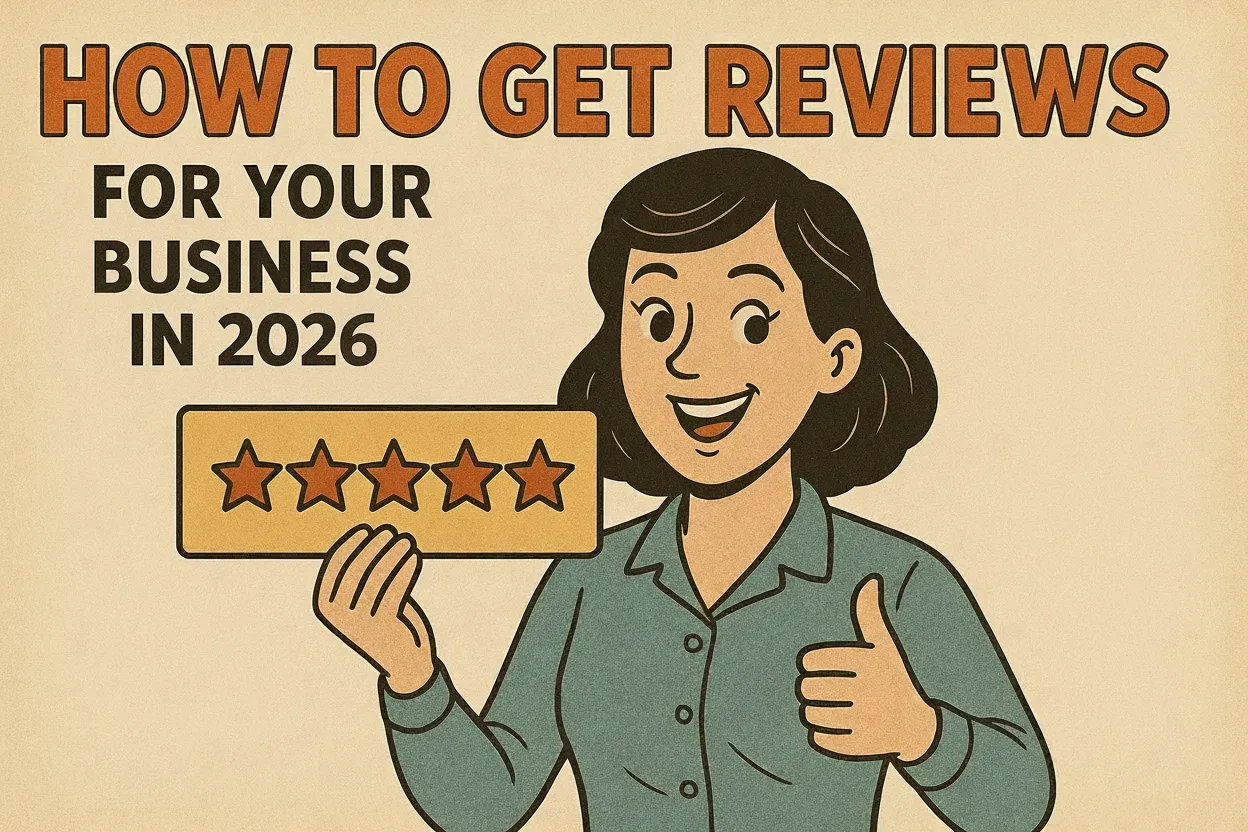
How to Get More Reviews for Your Business in 2026 (And Why They Matter More Than Ever)
 Adam Dowling
 8 min read