The Most Popular A.I. Chatbots in New Zealand (Comparison)

Adam Dowling
SEO Analyst & Copywriter-
 Share
Share
-
 No Comments
 -
 7 min read
Unless you’ve been asleep in a sensory deprivation tank for the last 18 months, you’ve probably bumped into an A.I. chatbot.
Need help replying to that passive-aggressive email? Boom. done.
Want to make a soufflé with just 3 ingredients? Voilà, chef mode.
Need a diagnosis on that weird rash? You got it! (my condolences).
A.I. is creeping into everyday life so fast that it’s basically moved in. But with dozens of LLMs (Large Language Models) to pick from, which one should you be using to organise your daily chaos?
We did a deep dive on the most popular AI chatbots used in NZ and put them to the test!
Why this Matters for Search & SEO in New Zealand
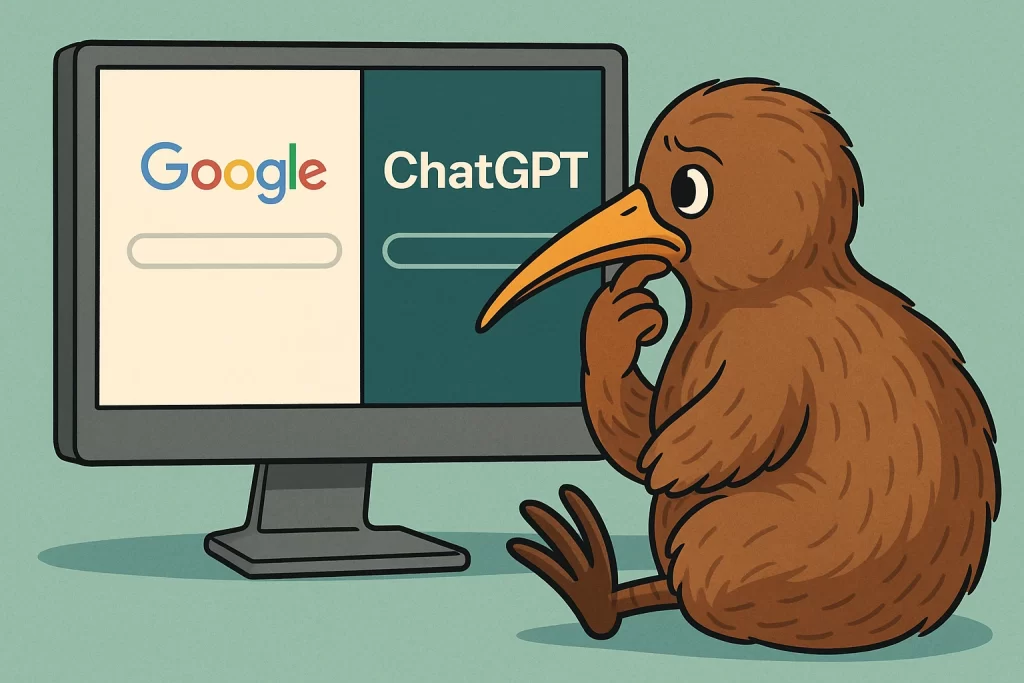
In the world of online discovery, traditional search engines still reign supreme. But the landscape is evolving fast. As of 2025, Google commands around 90% of the global search engine market share, handling over 80 billion visits per month. By comparison, ChatGPT sees roughly 6 billion monthly visits. Impressive, but still a fraction of Google’s reach.
Interestingly, research from Similarweb shows that 95% of ChatGPT users also visit Google, while only 14% of Google users visit ChatGPT. In other words, even people using AI chatbots still rely on traditional search to validate or expand what they find.
For New Zealand businesses, this shift signals opportunity. As more users start to mix AI chat and search, optimising for NZ-specific, conversational, and long-tail queries can help your site appear in both search results and AI-generated recommendations.
What is an LLM (Large Language Model)?
A Large Language Model (LLM) is essentially a predictive text engine on steroids. It’s trained on billions of words from books, articles, and websites, learning to generate text that sounds natural and contextually relevant.
Unlike traditional chatbots that follow scripted flows such as “Press 1 for sales,” LLM-based chatbots like ChatGPT and Gemini can generate unique responses, adapt to context, and handle complex prompts.
They can:
-
Understand tone and nuance
-
Generate creative content
-
Draw on live data (for some models)
-
Act as research or productivity tools
In short, AI chatbots are not just tools for techies. They’re becoming everyday assistants for planning, learning, and business communication.
Which A.I. Chatbots We Tested:
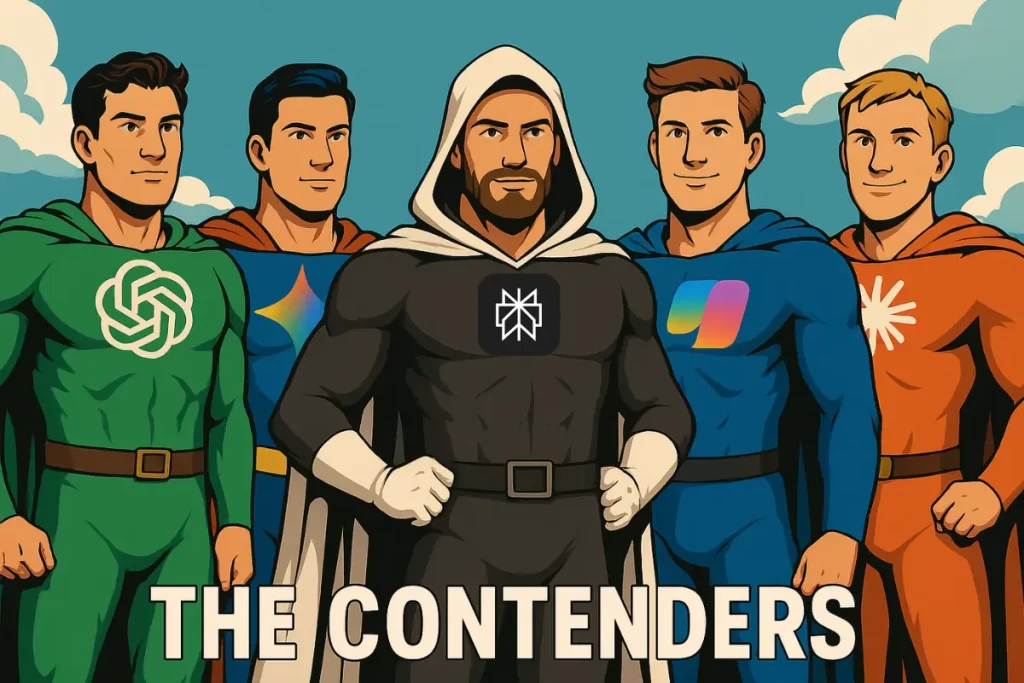
We lined up these five big names:
- ChatGPT (OpenAI)
- Google Gemini
- Microsoft Copilot / Bing Chat
- Claude (Anthropic)
- Perplexity
Every bot got the same prompt (see below), the same scoring criteria, and we gave them a score out of 10 for how usable they feel.
Our Testing Setup
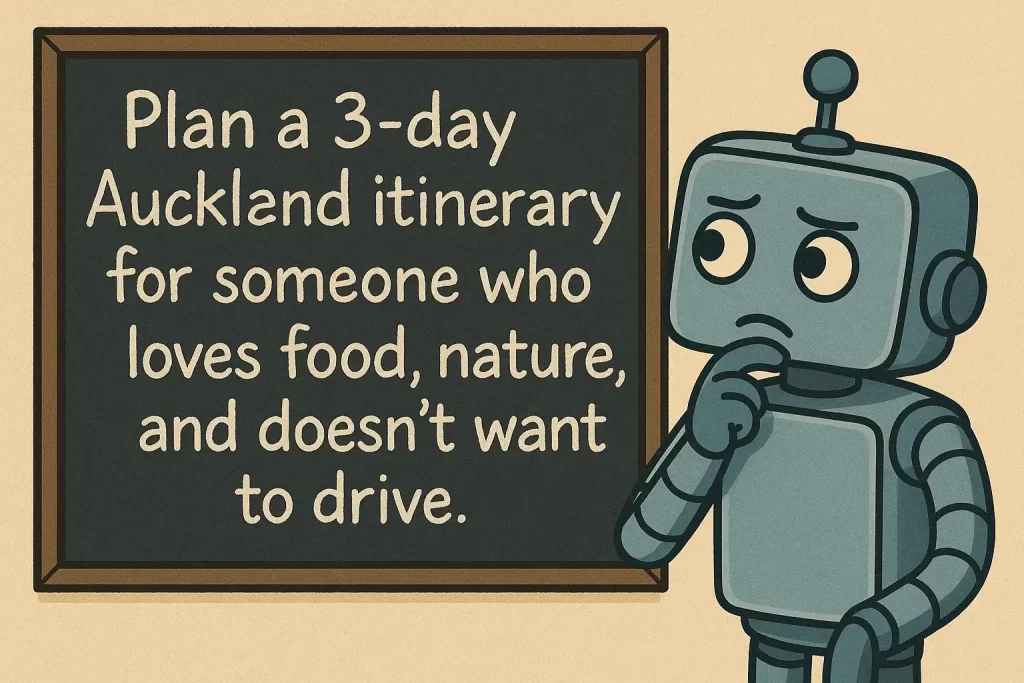
Prompt given to all:
“Plan a 3-day Auckland itinerary for someone who loves food, nature, and doesn’t want to drive.”
Why this? Because it forces them to juggle local knowledge, logistics, mood, and taste. A bot that gives a bland list of tourist traps loses style points. We judged on:
- Local flavour & relevance
- Practical logistics (walkability, public transport)
- Variety (food, green space, hidden gems)
- Tone/personality
- Clarity & usability
ChatGPT

The one your mum has probably asked you about. ChatGPT is by far the most popular LLM. In the world of LLMs, ChatGPT stands out for its broad accessibility and natural, human-like dialogue.
Quick Stats:
-
Global market share: ~81.1% (StatCounter 2025)
-
Latest release: GPT-5
-
Average response speed: 1–3 seconds
-
Paid plans: From US $20/month (approximately 35 NZD)
What We Liked:
-
Polished, human-sounding responses
-
Great balance of creativity and practicality
-
Excellent tone and flow
What We Didn’t:
-
Sometimes plays it safe (touristy picks)
-
Can drift off topic on long prompts
Verdict:
ChatGPT gave us a fun, practical Auckland itinerary full of local colour and personality. It leaned slightly touristy (Mount Eden, Ponsonby, Viaduct) but delivered a strong balance of creativity and usability.
Score: 8.5 / 10
Google Gemini
Google’s AI golden child, Gemini, was built to be the brain behind everything from Gmail to YouTube. It’s designed to integrate seamlessly into Google’s ecosystem, making it less of a standalone chatbot and more of an AI sidekick. Gemini pulls live data from across the web, making it great for current, event-based recommendations.
Quick Stats:
-
Global market share: ~2.8%
-
Pro plans: From US $19.99/month (approximately 35 NZD)
-
Integrates directly with Gmail, Google Docs, and YouTube
What We Liked:
-
Up-to-date restaurant and event info
-
Smooth integration with Google services
-
Balanced creativity and accuracy
What We Didn’t:
-
Feels cautious and formulaic
-
Misses some hidden gems
Verdict:
Gemini’s Auckland itinerary was accurate and timely, with fresh mentions of trending eateries and local markets. It’s ideal if you want current data rather than pure creativity.
Score: 8.0 / 10
Microsoft Copilot

Copilot is Microsoft’s “AI sidekick built into your tools.” If you live in Word, Excel, Windows – this is their attempt to be always useful.
Quick Stats:
-
Global market share: ~4.1%
-
Included in Microsoft 365; paid tiers available
-
Powered by GPT-4 + Microsoft integrations
What We Liked:
-
Works seamlessly within Word, Excel, and Teams
-
Great for summarising and task automation
-
Good blend of generative and search-based results
What We Didn’t:
-
Limited personality
-
Less adventurous in creative prompts
Verdict:
Copilot gave a structured and sensible Auckland itinerary, but it felt like it came from a travel agency brochure. Efficient, yes – but not exciting.
Score: 7.5 / 10
Claude

Claude brands itself as “safe, thoughtful, careful.” Less about flamboyant answers, more about staying grounded. Claude’s brand promise is “helpful, harmless, and honest.” It focuses on ethics and clarity rather than boldness.
Quick Stats
- Market Share: 1 %
- Latest Model / Release: Claude 4 / Sonnet variants (latest)
- Cost & Plans: Claude Pro $17 USD (30 NZD) per month for advanced features (larger context windows, faster performance)
What We Like
- Handles nuance and sensitive topics more gracefully
- Softer tone, fewer “bold claims gone wrong”
- Good guardrails
What We Didn’t Like
- Can be too cautious or safe
- Less daring or adventurous in suggestions
- Creative leaps are sometimes toned down
The Verdict
Claude’s itinerary was calm and thoughtful, perfectly walkable, well-balanced, and considerate of timing and flow. It avoided tourist traps, but maybe too much; a bit polite and understated. Ideal if you value relaxed pacing over bold discovery.
Our Score: 7.8 / 10
Perplexity

Perplexity is the “fact & source geek” in the lineup. It’s less about flair, more about grounding, citations, and live info. Perplexity’s strength lies in transparency and accuracy. It clearly shows sources and citations right in the chat, ideal for researchers and fact-checkers.
Quick Stats
- Monthly Users / Market Share: 10.9%
- Latest Model / Release: Mixes retrieval + LLM models (e.g. Mistral, GPT)
- Average Response Speed: Competitive, though heavy queries may slow slightly
- Cost & Plans: Perplexity Pro ~ US $20 / month (unlock better models, more throughput, priority access)
What We Like
- Excellent at citing sources & showing where info came from
- Strong at accuracy, grounding, and fact backing
- Transparent – you see evidence
What We Didn’t Like
- Less flair, less personality
- Tends to pick safe, “justifiable” options over wild creativity
- On poetic / “vibe” prompts, might feel stiff
The Verdict
Perplexity’s Auckland plan was the most fact-checked and cited, complete with links to restaurant reviews and public transport options. It nailed accuracy and practicality, but didn’t quite capture the city’s vibe. You’d eat well and get around easily, but miss a bit of that Auckland soul.
Our Score: 7.7 / 10
Other AI Chatbots Worth Watching in New Zealand
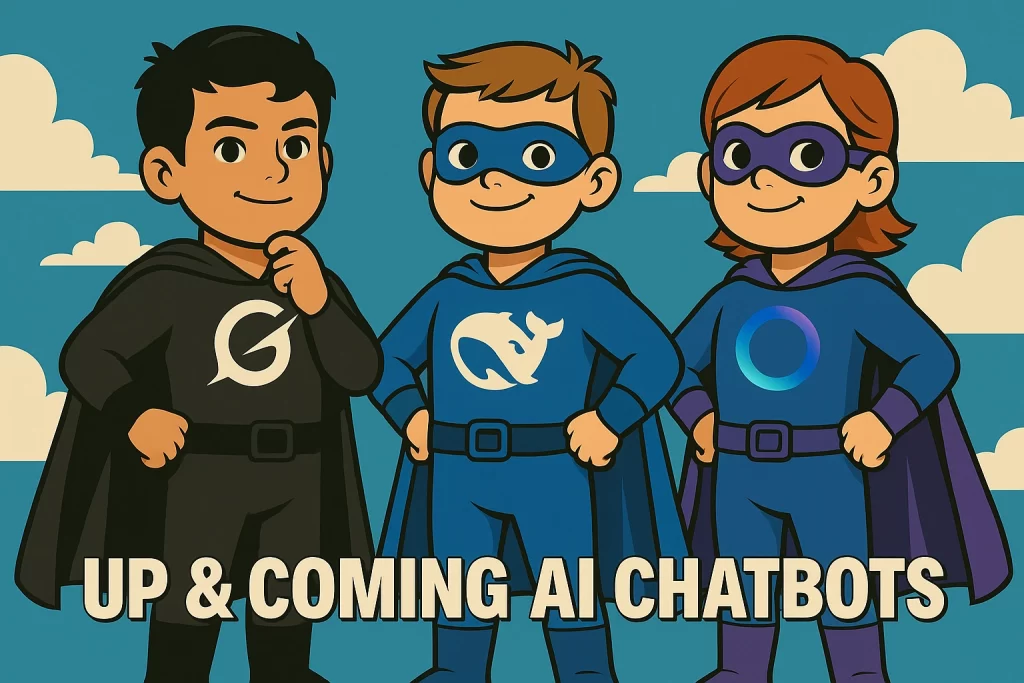
While the big five dominate usage, several smaller chatbots are gaining traction. Here are our honourable mentions:
-
DeepSeek – a fast-growing AI model out of China focused on reasoning.
-
Meta AI – Meta’s assistant is integrated across Facebook, Instagram, and WhatsApp.
-
Grok – developed by xAI (Elon Musk’s team), available inside X (formerly Twitter).
These have a lower market share in New Zealand right now, but including them in your research (or your website content) helps you capture niche long-tail searches.
So, Which AI Chatbot Should You Use in New Zealand?

It depends on what you’re using it for. Each chatbot has its strengths, so the right one for you comes down to your goals. Whether that’s creative writing, fact-checking, or boosting productivity.
💡 Which AI chatbot is best as an all-rounder?
If you want something that can handle just about anything, from writing and brainstorming to trip planning and emails, ChatGPT is still the strongest all-rounder. It is creative, intuitive, and easy to use for everyday tasks.
🌏 Which AI chatbot gives the most current, local results?
Google Gemini is the best option for live, up-to-date information. Because it pulls from Google’s own data sources, it is especially good for NZ-based searches, local restaurants, or trending topics.
📄 Which AI chatbot works best with Microsoft tools?
If your workday revolves around Word, Excel, or Teams, Microsoft Copilot is a natural fit. It integrates directly into Microsoft 365 and helps automate admin or content tasks within your apps.
🧠 Which AI chatbot has the most balanced, thoughtful tone?
Claude by Anthropic tends to be more measured and human-like in tone. It is ideal if you want clear, careful writing or are working on sensitive topics where tone matters.
📚 Which AI chatbot is most accurate and fact-based?
If you care about citations, transparency, and grounded answers, Perplexity stands out. It is excellent for research, summarising complex topics, or fact-checking, and it shows its sources.
🥝 So, which one should you use in New Zealand?
It really depends on what you need: creative writing, local research, or day-to-day productivity. Try a few and see which matches your workflow best. Each chatbot offers something slightly different. Let us know what your favourite AI chatbot is in the comments below!
Leave Your Comments
Subcribe to our newsletter!


Spotlight

 Emma Galtsov
  6 min read